
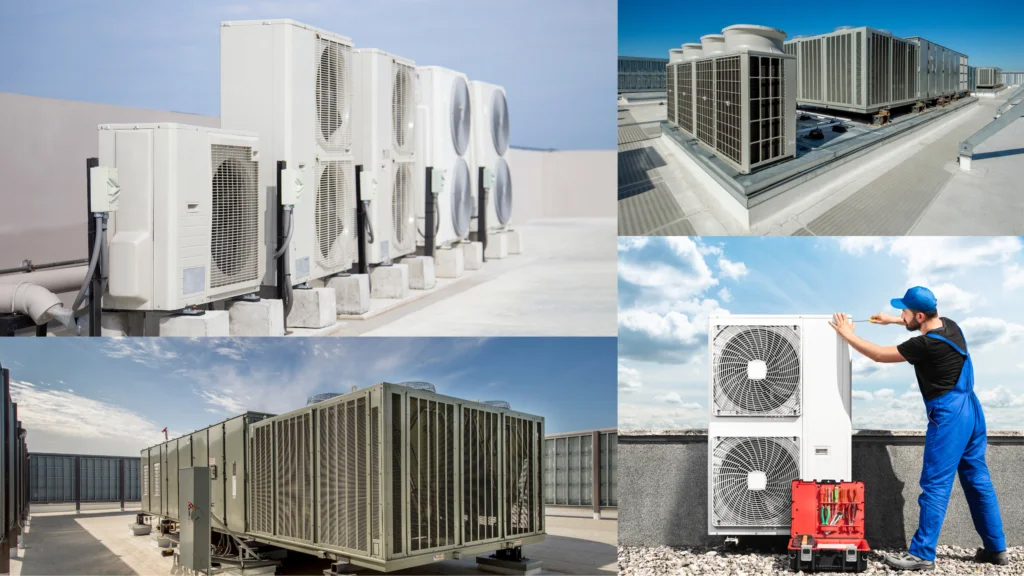
Introduction
Choosing the right HVAC (Heating, Ventilation, and Air Conditioning) system is a critical decision for any commercial or industrial space. A well-selected system ensures efficient cooling, energy savings, and long-term reliability, while the wrong choice can lead to higher operating costs and inconsistent performance.
With multiple options such as VRF systems, ductable units, cassette air conditioners, and air handling units, it is important to understand which solution best suits your specific requirements.
Understand Your Space Requirements
The first step in selecting an HVAC system is evaluating the space where it will be installed. Factors such as total area, ceiling height, number of occupants, and heat-generating equipment all influence the cooling load.
For example, office spaces, retail showrooms, hospitals, and industrial facilities all have different cooling needs. A proper assessment helps in choosing a system that delivers uniform cooling without overloading or underperforming.
Energy efficiency is one of the most important factors when selecting an HVAC system. Modern systems are designed to consume less power while delivering high performance. An energy-efficient system not only reduces electricity bills but also contributes to environmental sustainability. Investing in the right system can result in significant long-term savings.
Types of HVAC Systems
- VRF / VRV Systems: Variable Refrigerant Flow (VRF) systems are ideal for large commercial buildings. They allow multiple indoor units to be connected to a single outdoor unit, offering flexibility and individual temperature control for different zones.
- Ductable Air Conditioning Systems: Ductable systems are centralized solutions that distribute air through ducts. They are perfect for spaces requiring clean interiors and uniform airflow, such as offices, malls, and auditoriums.
- Cassette Air Conditioners: Cassette AC units are ceiling-mounted systems available in 1-way, 2-way, and 4-way airflow configurations. They are suitable for compact spaces and provide efficient air distribution without occupying wall space.
- Air Handling Units (AHU) : AHUs are used in large HVAC setups to regulate and circulate air. They play a key role in ventilation, filtration, and maintaining indoor air quality.
Installation and System Design
Even the best HVAC system will not perform effectively without proper design and installation. Professional planning ensures correct equipment selection, proper duct layout, and efficient airflow distribution. Expert installation minimizes issues such as air leakage, uneven cooling, and system failures, ensuring smooth and reliable operation.
Maintenance and Long-Term Performance
Regular maintenance is essential to keep your HVAC system running efficiently. Scheduled servicing helps in detecting potential issues early, improving system lifespan, and maintaining consistent performance. A well-maintained system reduces downtime and ensures uninterrupted comfort for occupants.
Conclusion
Choosing the right HVAC system requires careful evaluation of space, system type, energy efficiency, and installation quality. Whether it is a VRF system for large buildings or a ductable solution for uniform cooling, the right choice ensures comfort, efficiency, and long-term reliability. Consulting with experienced HVAC professionals can help you make the best decision and achieve optimal system performance for your space.